
The MVP isn’t the smallest product. It’s the smallest credible product.
Prototype vs Product Iceberg
Vibe coding is real magic: you can go from idea to clickable in days (sometimes hours).
But that “clickable” is usually a widget, not a system.
And customers don’t buy widgets. They buy confidence:
“This won’t break.”
“This feels intentional.”
“This team is serious.”
“I can recommend this.”
If you’re a medium-sized business or a funded startup, that gap matters—because the moment you go from demo to real users, quality becomes the product.
The mainstream belief (and what it misses)
Belief: “Vibe coding allows anyone to launch their own digital app.”
Reality: Vibe coding helps you start. Launching means you can:
support real users
handle edge cases
keep things consistent as you add features
protect trust when something goes wrong
A clickable UI is proof you can build. A refined system is proof you can deliver.
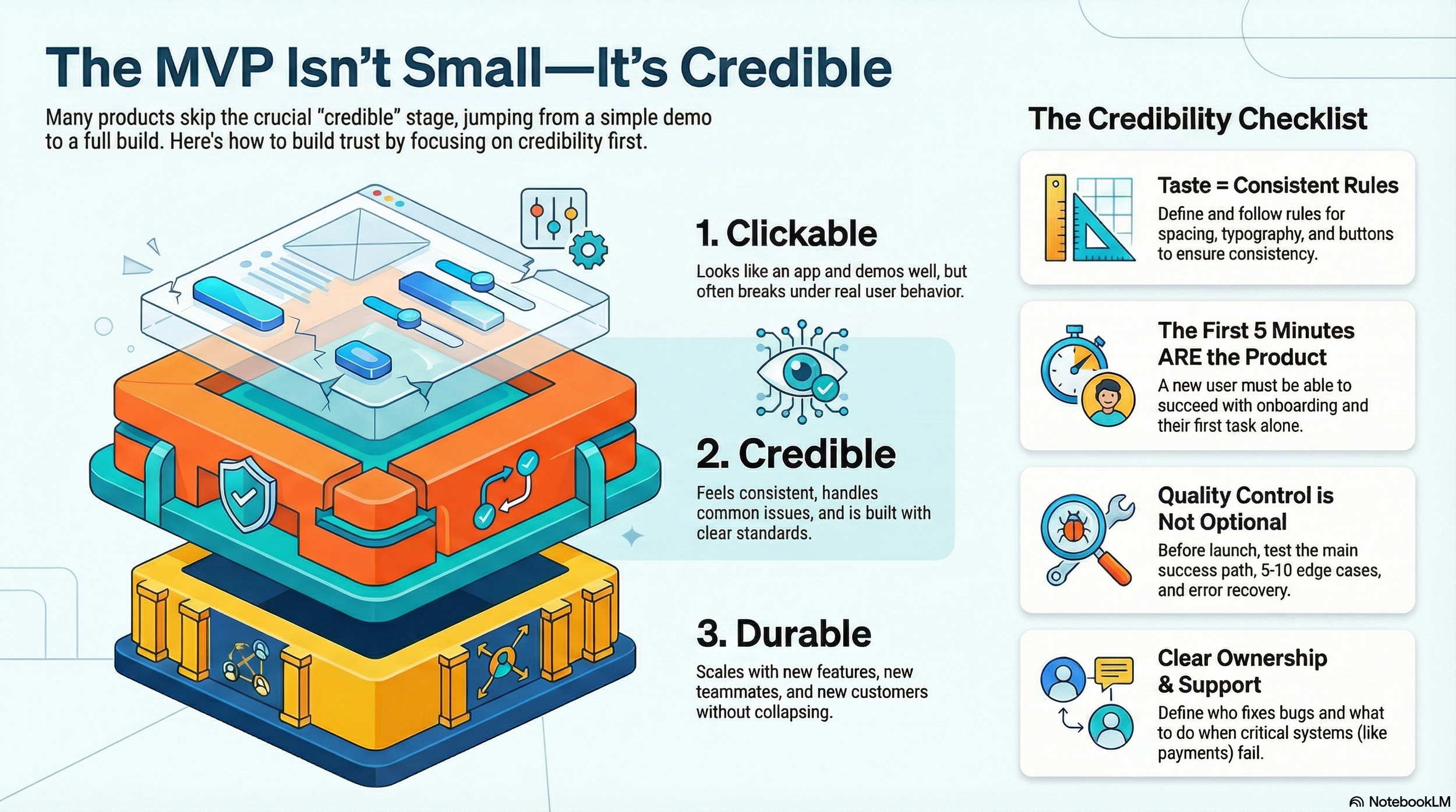
The 3 layers of “ready” (most teams skip layer 2)
Clickable: Looks like an app. Demos well. Often breaks under real behavior.
Credible: Feels consistent. Handles common edge cases. Has standards. Doesn’t surprise users.
Durable: Scales with new features, new teammates, and new customers without collapsing. Most vibe-coded projects jump from clickable → durable and wonder why shipping slows down. The missing step is credible.
What makes something “credible” (the checklist that actually matters)
1) A single sentence that explains the product
If you can’t explain the value in one sentence, the UI will be confusing no matter how pretty it is.
Test: “A user comes here to ____ so they can ____.”
The single sentence is more challenging than you will think. That is where product strategy reduces rework.
2) Taste = consistent decisions (not personal preference)
“Taste” isn’t fancy. It’s rules you follow:
spacing rules
typography rules
button rules
error rules
empty-state rules
No rules = every screen is a new argument.
3) The first 5 minutes are the product
Onboarding, first task, and first success moment decide if they stay.
Test: Can a new user succeed without a call with you?
4) Quality control is not optional
At minimum, you need:
a happy path test
5–10 common edge cases
error states that help the user recover
basic performance checks
If you’re shipping without this, you’re shipping stress into your own calendar.
5) Analytics that answer one question: “Are people getting value?”
Not “page views.” Value. Pick 1–2 activation events and track them. Add one real metric you care about (activation, retention, conversion).
6) Support and ownership: “Who fixes what?”
Even if it’s just you, write it down:
bug intake path
response time expectation
“what happens if payments fail?” (if relevant)
Credibility is also operational.
MVP needs credibility
A practical decision tree (use this before you “launch”)
If you’re pre-seed / experimenting:
Ship the clickable. Learn. But don’t call it “ready.” Call it “testable.”
If you’re funded / selling to real teams:
Do a Credibility Sprint before you market hard:
UX rules + component cleanup
copy pass (microcopy + empty states)
QA checklist + bug triage
analytics events
basic performance pass
If you’re mid-market (brand and trust matter):
Treat it like a product launch, not a demo:
design standards
content and brand consistency
accessibility basics
security/privacy basics (where applicable)
operational readiness
Why “refinement” is now the advantage
When everyone can generate interfaces, the difference becomes:
clarity
consistency
reliability
taste
operational readiness
That’s what makes an app stand out in the vibe-coded flood.

If you have a vibe-coded prototype and you want it to feel customer-ready, Color Culture can run a Credibility Sprint.
Turn “Clickable” into “Confident”
Book a call today
If you’re a funded startup or a growing business and you want your product to look and behave like a real company built it (because one did), Color Culture Design Company can help you ship with standards—product strategy, UX delivery, low-code execution, and applied AI where it makes sense.
FAQs
Is vibe coding “bad”?
No. It’s excellent for speed and learning. The risk is mistaking speed for readiness.
What’s the difference between a prototype and an MVP?
A prototype proves the idea can exist. A credible MVP proves users can succeed reliably.
What should I refine first?
Onboarding + your top “success path” screen. If those are messy, everything feels messy.
How do I make “taste” less subjective?
Write rules (spacing, type, components, content patterns) and apply them across screens.
Can low-code tools still be production-ready?
Yes—when you treat standards, QA, analytics, and ownership as first-class work.